


Seems like a pretty straightforward topic, doesn’t it?
Honestly, I’m also a bit surprised I’m having the motivation to write about it. I’ve been wanting to for a long time, as during my consulting years I’ve found myself quite a lot of times in a situation to propose, recommend, or just assist in the selection of a BPM (Automation) Tool.
(I’m writing Automation in brackets on purpose, as again, more often than not, it became obvious that Automation was not the only requirement!)
So, let’s get into the topic. As I’ve already mentioned, it should be easy. It’s like buying a car basically, isn’t it? You know that you want a SUV, Caravan, Sports car, Limousine, etc. You know roughly which brand you prefer, what equipment is essential and what is not, and, very importantly, your budget.
You will also typically want to ask around people you know about that car you like and ask for their opinions, am I right? And finally, you will for sure take your dream car for a test drive. Or maybe even try out 2 or 3 cars that are on top of your wish list. Probably I haven’t covered everything, but in a nutshell, that would be the process. So, what makes choosing a BPM (Automation) Tool, or any corporate tool for that matter, different?
Well, first of all, it’s not only you or your closest family who is going to be using the purchased product. Secondly, it’s not “only” your private budget you are using, and often it’s a strategic decision that will impact the company for years to come. You must remember that it’s not only the cost of the platform and maintenance, but also that you have to take into account time and competencies of a lot of your colleagues. Sure, that could be true with a car, where your husband would prefer the automatic, as he does not know how to drive a manual, just for an example.
Anyway, you get the point. It’s similar, but still very different. As I’ve mentioned already, you would typically want to check with people you know what they think about your choices, and what are their experiences. This is also quite a bit more difficult in the scenario where you choose a corporate BPM Automation Tool, as the number of people you can ask is more constrained. Almost everyone drives a car, but how many people you know that use BPM and Automation every day?
Ok, so enough about the car. I’m now going to try to outline the process itself, some general guidelines that I’ve found useful over the years, and even an example scoring template that you can download at the very end of the article.
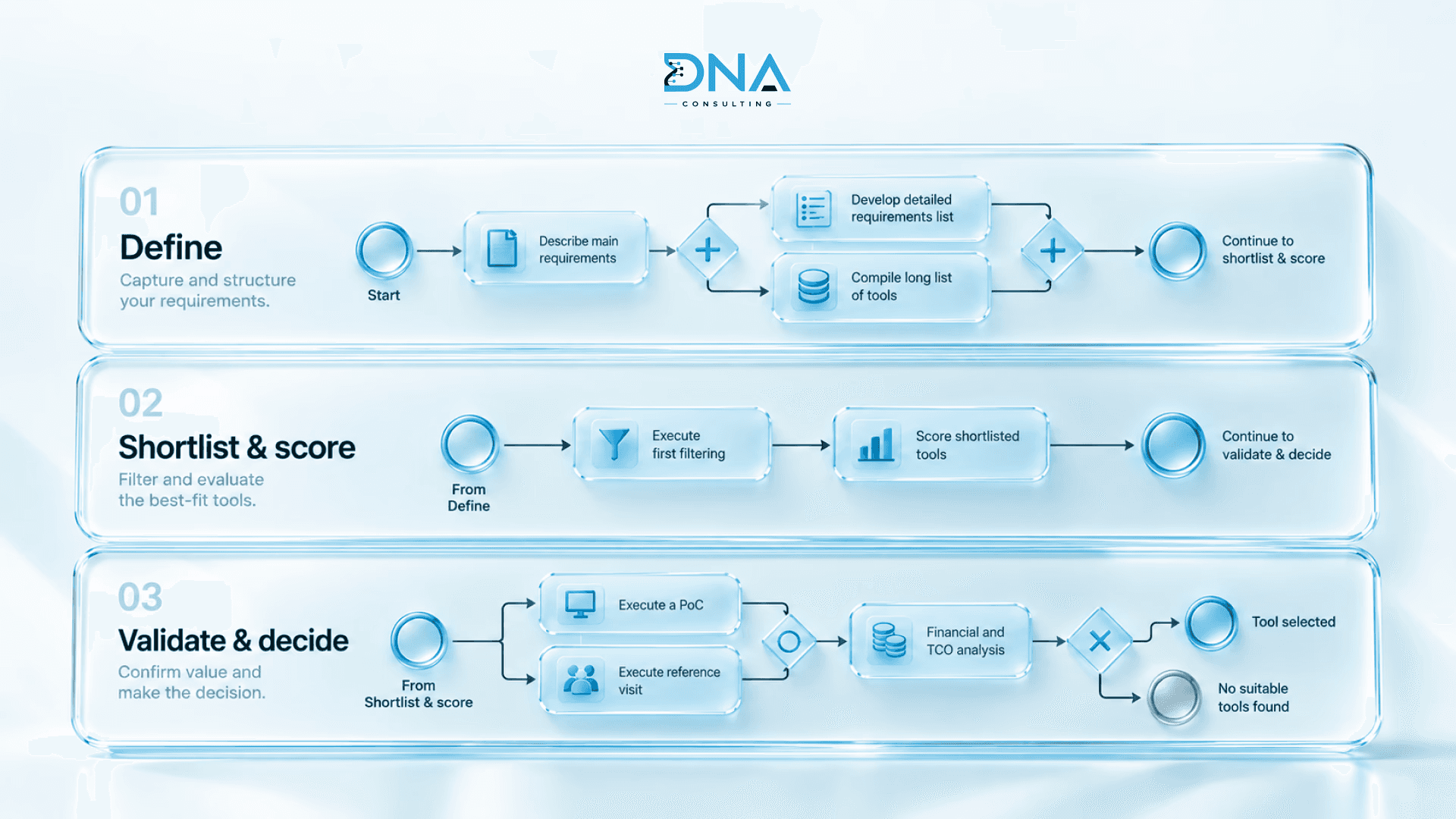
The Process
a. Describe the main requirements in short
b. Develop a more detailed selection methodology (parallel)
c. Compile a “long-list” of possible platforms (parallel)
d. Execute the first filtering
e. Apply the detailed selection methodology to a filtered list
f. Evaluate the final list of platforms (recommendation to have 1-3)
i. PoC?
ii. Reference visits?
iii. Experiences from other people within the company, if already
used
g. Financial and TCO analysis
General Guidelines
a. As already mentioned in the process, try to be very clear about the main requirements for the tool. Do you “just” want to use it mainly for process automation, or is documentation of business processes equally important? Do you want to use Process Mining? Simulation functionalities? Or something additionally?
b. Try to keep an open mind, not searching for a silver bullet, if you are looking for the tool to fulfil more purposes. It’s not always that one tool, platform or vendor is the best for every purpose! Often, it’s better to integrate best of breed platforms, than get just one that is best at something, but the other functionalities you need are not optimal.
c. Try to consider that often bigger vendors have grown by acquiring smaller companies and their tools/platforms, where they paint you a fully integrated suite picture for you, but sometimes seamless integration between the modules of their single tool/platform is less optimal than doing an integration of several tools from different vendors.
d. Don’t take the reports from the big analyst houses for granted. Not saying that they are not good guidance, but don’t cross out some other tools because they are not mentioned there. Be at least aware that some of the vendors don’t even want to be listed there, as there is a fee to pay for your tool to be evaluated, and bigger companies have more marketing budget to do so, than some pure-play vendors who are investing more in their tool and
functionalities then marketing.
e. Think seriously about considering a platform that is already used by someone within the enterprise already. Maybe they were a pioneer of BPM Automation within the company, without even knowing it, or they’ve done a PoC already. Try to ask around first internally within your company.
f. Try to consider tools that have an open-source approach, or at least an open architecture and are implementing some global standards. For example, BPMN and DMN.
g. Try to avoid vendor lock in and watch out for very proprietary and complex notations, standards and customization methodologies. These will result in bigger risk of finding resources you need, and overly dependent on a single service provide/vendor. Isn’t it easier to find people who know Java, JavaScript, C#, then people who know COBOL or ABAP? Same goes for BPMN versus other notations that are not a global standard.
h. This is a hard one, but try to execute a small enough, but relevant PoC with ideally one, and at maximum 2-3 tools. More than that is very likely not feasible. This also depends on how much budget you must invest in it. Make sure you are aware that you will have to use your own time and resources, plus very likely must pay for external(vendors) resources sometimes. Typically, a PoC has a duration of 1-3 months, and requires at least 15-30
MD’s (man days).
3. Scoring Template Helper
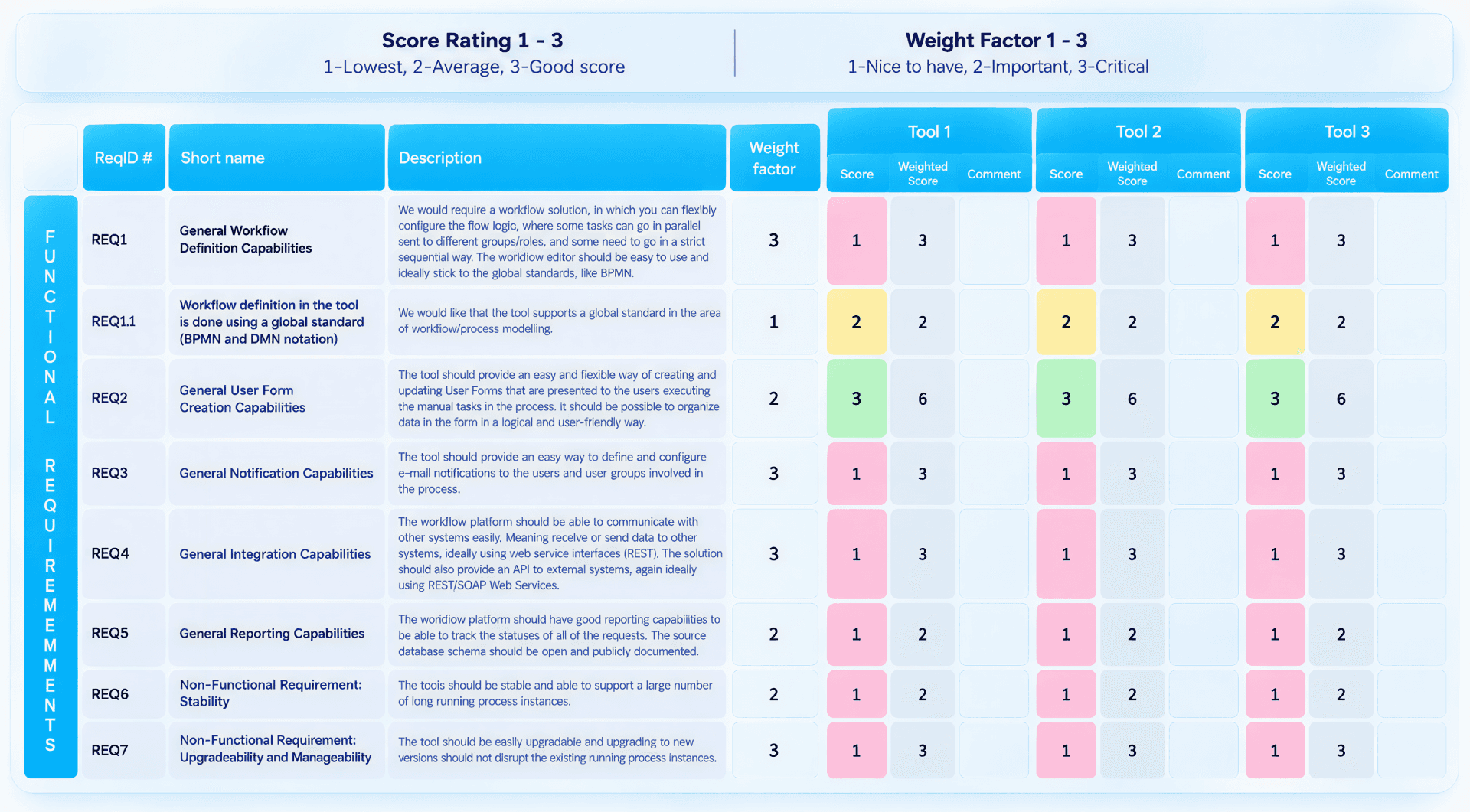
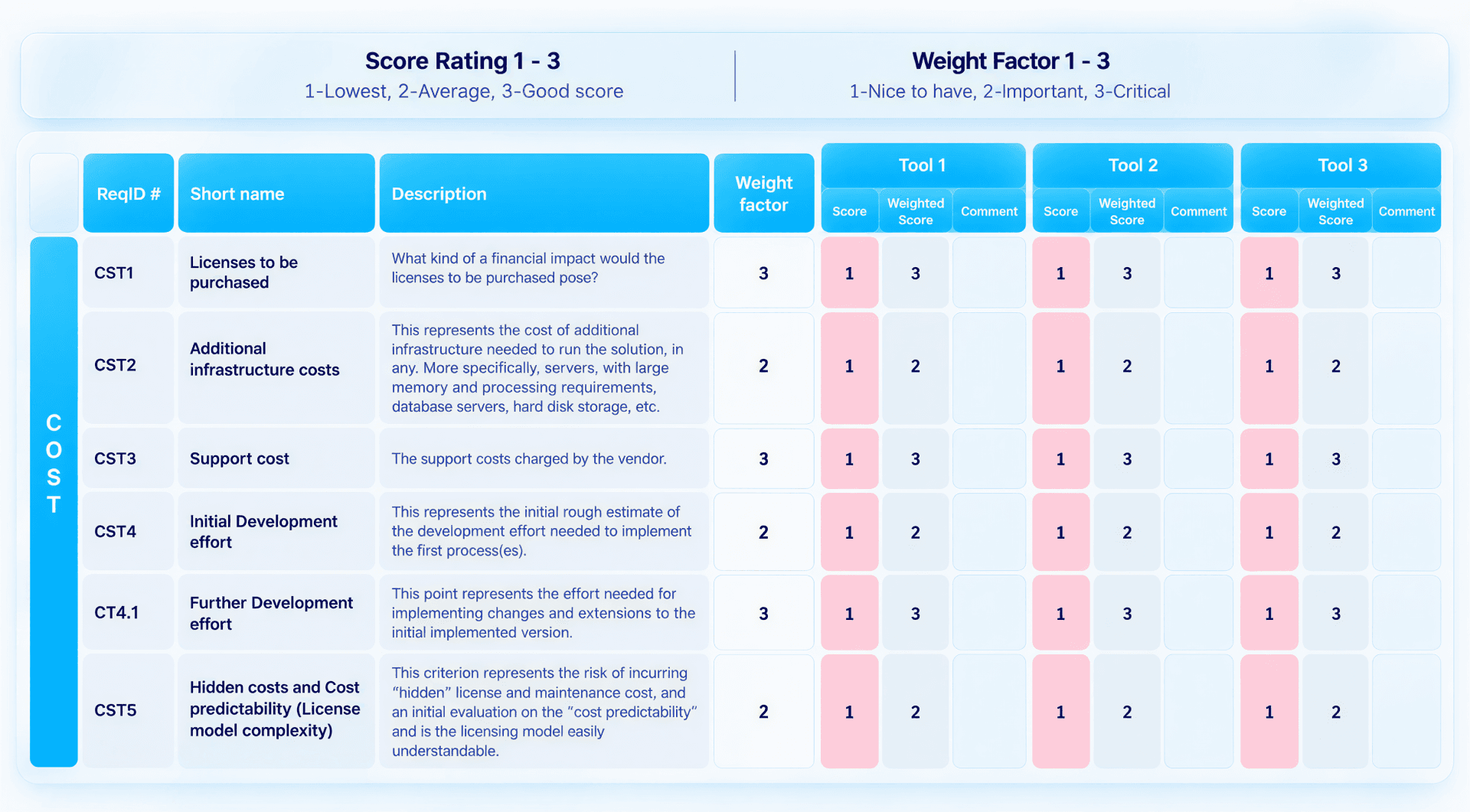
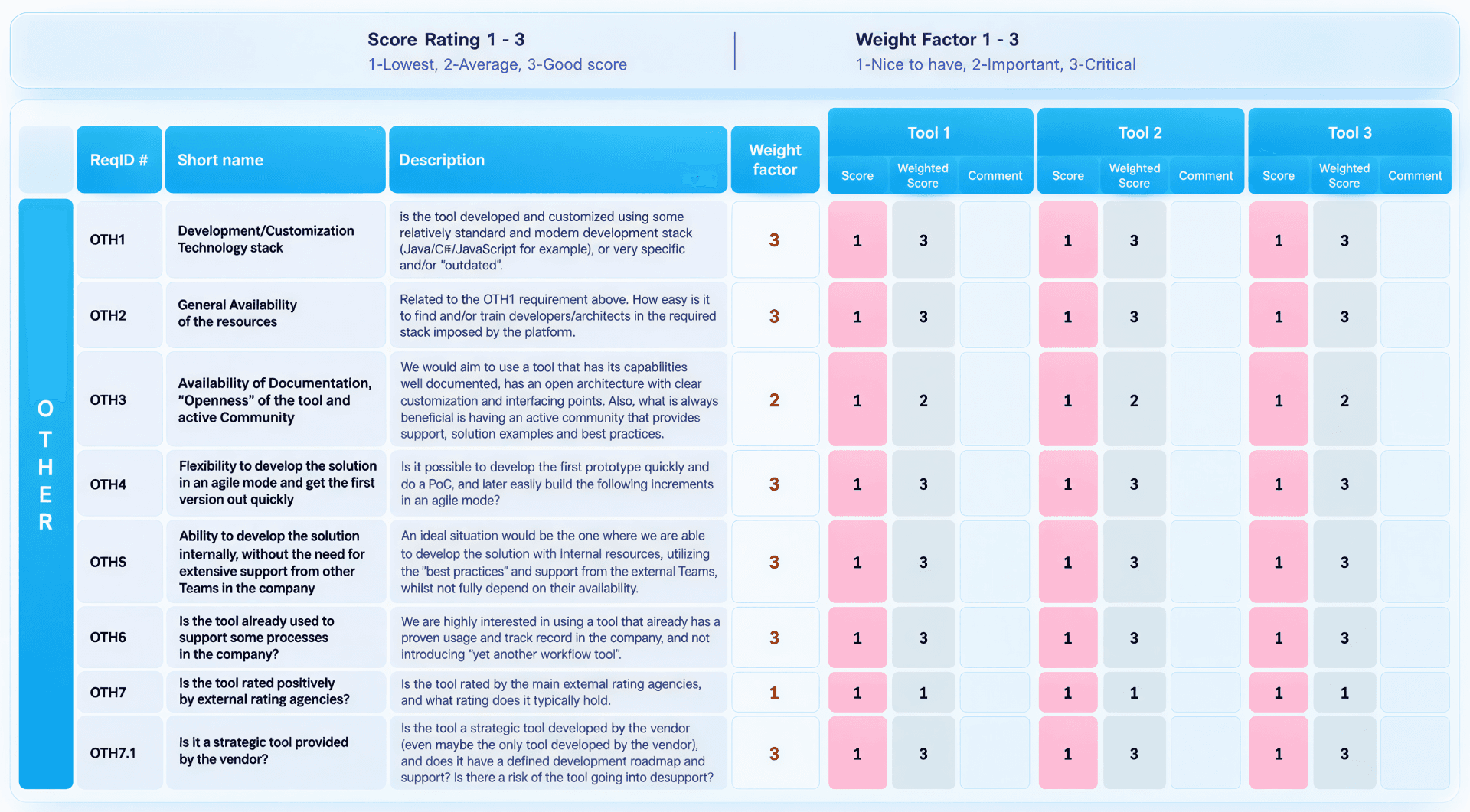
Download rating sheet
Written by:

Nikola Dlaka
Managing Partner
Share with friends: